Homeowner guide — Las Vegas, NV
Water Damage in Las Vegas Homes: the Homeowner's Guide
Last updated: September 2026
The no-panic version of this site: how to spot water damage early, what to do in the first hour, how monsoon season changes the math, and how Nevada insurance actually treats water claims. For current prices see the cost page; for who's reputable, the company list.
Early Signs of Water Damage in Walls
Water announces itself quietly before it announces itself expensively. In walls: paint bubbling or peeling in a stripe or patch; baseboards swelling, warping or pulling away from the wall; drywall that feels soft or crumbles at a touch near the floor; a musty smell that cleaning doesn't remove; and discoloration — yellow-brown staining that grows between cleanings. In Las Vegas specifically, add the slab-leak tells: a warm stripe on the floor and a water meter that won't stop (details on our slab leak page).
On ceilings: staining near AC vents or under rooftop units points to condensate overflows — the valley's summer signature. A ceiling stain that appears in June and stops in September is not "fixed"; it's seasonal, and it's growing something.
First Steps After You Find Water
1. Stop the source. Fixture valve, appliance valve, or the main shutoff (garage, water heater, or ground box near the street). 2. Protect people: power off to wet areas; sewage or floodwater means nobody touches it. 3. Document with your phone before anything moves. 4. Move valuables out of the spread path and get furniture legs onto foil or blocks. 5. Call for extraction the same day — see the emergency page for the full first-hour checklist.
What not to do: don't run the HVAC if water is near returns or the air handler; don't assume the dry-feeling surface means a dry wall; and don't wait "to see if it dries" — in Las Vegas heat, the mold clock runs in hours, not days.
Monsoon Season: July Through September
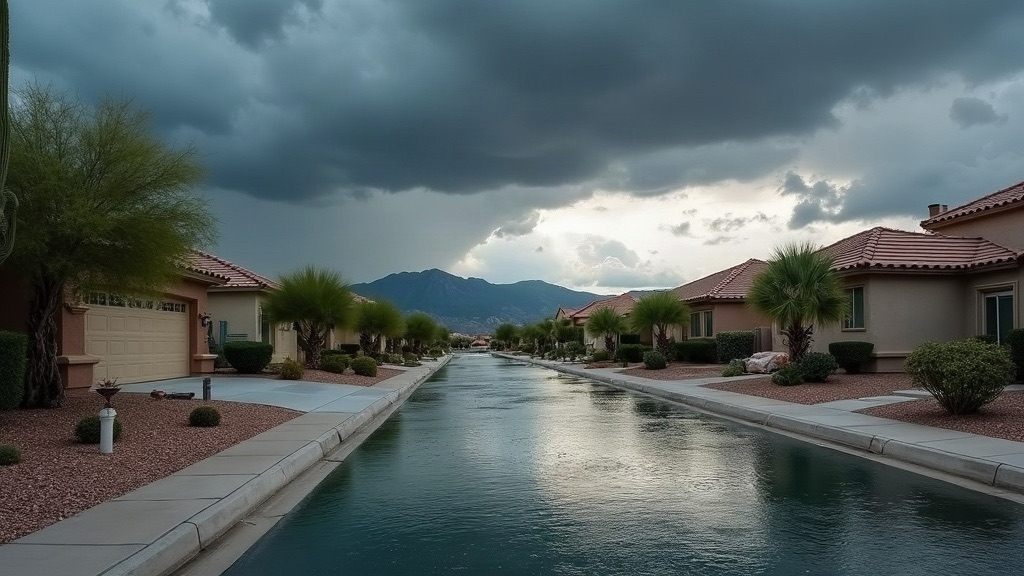
The North American monsoon pulls Gulf moisture into the Mojave each summer, and Las Vegas takes most of its annual rainfall in short, violent afternoon storms. Desert soil can't absorb the rate, the valley's wash corridors fill in minutes, and flash flood warnings become routine. The homes at risk are predictable: anything near a wash, at the bottom of a slope, or in the valley's known low points.
Before the season: clear yard drains and scuppers; check door thresholds and weatherstripping; know where your main water shutoff and breaker panel are; photograph your home's condition for a baseline. Important: monsoon floodwater entering from outside is Category 3 contamination and is excluded from standard homeowners policies — flood insurance (NFIP or private) is a separate purchase, typically with a 30-day waiting period. June is the month to buy it, not August.
After a flood event: treat all floodwater as contaminated, document the water line on every wall before cleanup, and expect restoration demand to spike valley-wide — the companies with real 24/7 dispatch on our list triage by severity on storm nights.
Ceiling Water Damage: the AC Condensate Problem
Las Vegas runs air conditioning 20+ hours a day in peak summer, and every system makes condensate — gallons per day. When the drain line clogs or the overflow pan fails, that water goes into the ceiling assembly or wall cavity. Swamp coolers add their own failure mode: constant water on the roof, one stuck float valve away from an overflow.
The signs: staining or bubbling near vents, a drip that appears only when the AC runs hard, musty smell from one register. The fix is two trades: HVAC clears the drain line; restoration dries the assembly. Turn the unit off until the leak is stopped — it manufactures water all day.
Insurance Basics for Nevada Homeowners
The coverage question is always about cause, not damage. Covered by a standard policy: sudden and accidental events — burst supply lines, failed water heaters, appliance hose failures. Not covered: gradual leaks (the slab leak you watched for six months), maintenance failures, and outside floodwater (separate flood policy). Mold is covered when it results from a covered event, usually up to a sublimit of $5,000–$10,000.
Three habits that decide claims: document before cleanup (photos, video, the source); mitigate immediately (policies require you to prevent further damage — waiting hurts you twice); and keep the restoration company's moisture logs and scope — that documentation is what adjusters pay on. A company that documents for insurance by default is worth real money; ask about it when you call.
Guide questions,
answered
Bubbling or peeling paint, swollen or separated baseboards, soft drywall near the floor, musty odor, and yellow-brown staining. In Las Vegas homes, add warm floor stripes and a spinning water meter — the slab leak signatures.
July through September, with the peak typically late July to mid-September. Flash flood warnings are routine during this window; homes near washes and low points should prep drainage and door thresholds in June.
No. Dry air dries surfaces, not wall cavities. Moisture trapped in walls, cabinets and flooring sees none of that desert air — and summer heat accelerates mold growth there. Dry-out is a mechanical job, not a waiting game.
Generally no — gradual damage is a maintenance exclusion. This is why the early-signs section matters: a caught-early leak is a plumbing bill; a long-ignored one is an out-of-pocket remediation.
Found the signs? Don't wait on it.
Water damage is one of the few home problems that gets more expensive by the hour. Call now — the line is answered 24/7.