Slab leaks — Las Vegas, NV
Slab Leak Detection & Repair in Las Vegas
Last updated: September 2026
Other cities worry about flooded basements. Las Vegas doesn't have basements — caliche hardpan and construction economics put every home on a concrete slab, with the plumbing buried in or under it. So the Las Vegas version of the basement-flood page is this one: the pipe you can't see, leaking into the concrete you stand on.
Slab leaks here are common enough to support a standalone leak-detection trade. Below: how to recognize one, what detection and repair cost, and the repair-method decision that determines whether your floor gets jackhammered.
Quick answer
Slab leak detection runs $150–$600 in Las Vegas; repair runs $500–$4,000+ depending on method — spot repair through the slab, or a reroute of the line overhead. Why Las Vegas? Homes sit on concrete slabs with copper lines in them, and the valley's hard water corrodes those lines decades early. This is the valley's signature water damage.
No Basements in Las Vegas — Here's What That Means for You
If you searched "flooded basement Las Vegas," the honest answer is: your home almost certainly doesn't have one. Basements are rare across the valley because caliche — the cemented hardpan layer under desert soil — makes excavation expensive, and slab-on-grade construction became the universal standard. Flood risk here lives at floor level.
That changes everything about water damage: a burst line doesn't fill a basement you can pump out — it spreads across your only floor, wicks into every wall base it touches, and, when the leak is in the slab, heats your tile and doubles your water bill before you see a drop. The slab leak is the Las Vegas water problem; this page is the deep dive, and our emergency page covers what to do tonight.
The Signs: Catch It Before the Floor Does
- A warm stripe on the floor. A hot-water line leaking under the slab heats the tile or laminate above it. Bare feet are the cheapest leak detector in Las Vegas.
- The meter test. Everything off — ice maker, sprinklers, softener. If the water meter's flow indicator still spins, water is leaving a pressurized line somewhere. Somewhere is usually under the slab.
- The sound of water with everything off. A hiss or faint running-water sound at night, loudest near the kitchen or bathrooms.
- A water bill that doubled. A 1/8-inch pinhole leaks thousands of gallons a month. The bill often arrives before any visible sign.
- Baseboards swelling or paint bubbling in a stripe a foot above the floor. Water from the slab wicks up into bottom plates and drywall.
- Cracks or heaving in the floor. Late stage: water erodes soil support under the slab and the concrete moves.
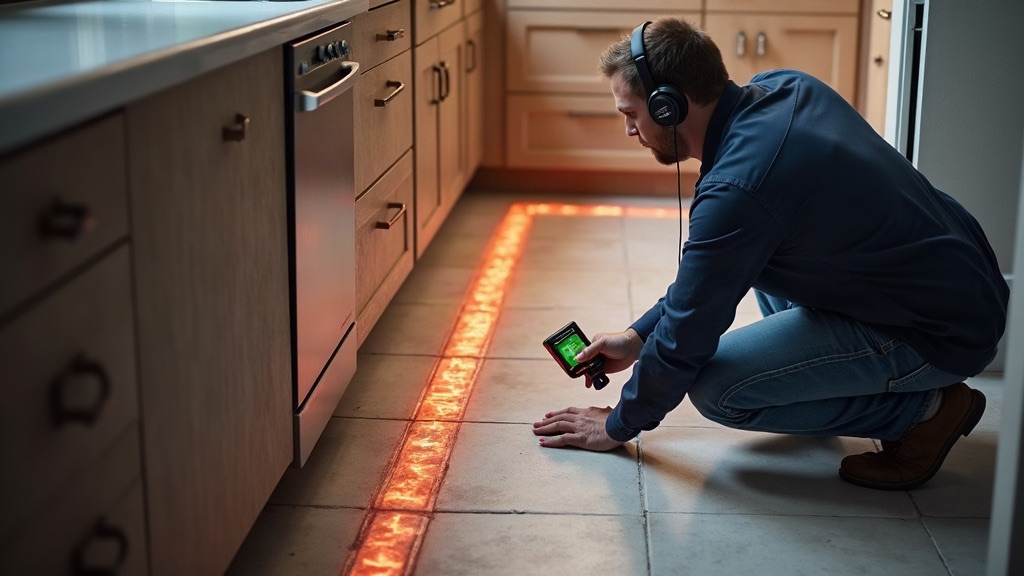
Slab Leak Detection & Repair Cost in Las Vegas
Detection (acoustic and thermal location, usually 1–2 hours): $150–$600. Spot repair through the slab (jackhammer, repair, patch): $500–$2,000. Reroute (abandon the slab line, run new PEX overhead through walls/attic): $1,000–$4,000 for a single line. Full repipe for a home with multiple failures: $4,000–$10,000+. Ranges are compiled from national cost data plus published Las Vegas–area pricing, September 2026. Every job is scoped on site — treat these as planning numbers, not quotes.
Note what's not in those numbers: drying and restoring the water damage the leak caused. That's a separate mitigation job — see what restoration costs — and it's often larger than the plumbing repair.
Why Las Vegas Slab Leaks Are an Epidemic
Three factors stack. First, construction: valley homes from the 1960s through the 2000s building booms are slab-on-grade with soft copper lines in or under the concrete — the leak-prone layout by design. Second, water chemistry: Las Vegas municipal water is among the hardest in the country, and mineral content plus soil chemistry corrodes copper from both sides. Third, expansive soil movement: desert soil swells in monsoon saturation and shrinks in drought, flexing the slab and stressing the lines inside it year after year.
The practical implication for homeowners: if your home is pre-2000s with original copper, a slab leak is a "when," not an "if." Annual attention to the signs above is cheaper than any deductible.
The Repair Decision: Jackhammer or Reroute?
Spot repair opens the slab at the leak location and fixes that section. Cheapest today ($500–$2,000), correct when the home is newer and the line is otherwise sound — but it means jackhammering your floor, and it leaves the rest of the aging line in the ground.
Reroute abandons the under-slab line entirely and runs new PEX through walls or attic ($1,000–$4,000 per line). No floor demolition, and no future leaks on that line — the right answer for most homes with 30+ year-old copper, because a second slab leak on the same line is common.
Full repipe makes sense after the second or third leak: every pressurized line replaced overhead ($4,000–$10,000+). Painful once; ends the problem permanently. A plumber quoting spot repair on a home with a leak history without mentioning reroute is optimizing for today's ticket, not your next five years.
Detection: What You're Paying $150–$600 For
Real leak detection is an instrument job: acoustic listening equipment to hear the leak through concrete, thermal imaging to map the hot-water signature, pressure isolation to confirm which line, and sometimes tracer gas for stubborn cases. The output should be a marked location — a spot on your floor, not a shrug.
Detection is billed separately because it's a specialty — many restoration companies and even plumbers subcontract it. Ask who performs it, and confirm the detection fee is credited or waived if the same company does the repair (common practice, worth asking for).
Frequently asked
questions
The classic triad: a warm spot on the floor, the sound of running water with everything off, and an unexplained jump in the water bill. Confirm free in five minutes: turn off every fixture and watch your water meter's flow indicator — if it moves, a pressurized line is leaking.
Detection $150–$600, spot repair $500–$2,000, reroute $1,000–$4,000 per line, full repipe $4,000–$10,000+. Water damage restoration from the leak is a separate job ($1,200–$5,000 typical). See our cost page for the restoration side.
Policies usually cover the resulting water damage and sometimes the "tear out and replace" cost of accessing the pipe — but not the pipe repair itself, and gradual leaks you ignored can be excluded entirely. Report early, document everything, and ask your adjuster specifically about access coverage.
Spot repair for a newer home with a first-time leak in an isolated cause (a rock, a kink). Reroute for homes with 30+ year-old copper or any leak history — it costs more today and eliminates the most failure-prone pipe in your house. Get both prices before deciding.
A licensed plumber (NSCB C-21) repairs the pipe; a restoration company dries the damage. They're different licenses and usually different companies — though several on our companies list coordinate both.
Suspect a Slab Leak? Call a Las Vegas Specialist
Available 24/7 — speak with a local specialist now.
Call (725) 705-7026This site is a directory, not a restoration company. See how we work and our privacy policy.